26 October 2026By Stephane Cornille
Pricing Strategy for Dealers & Galleries: 4 Rules for Selling Online
TL;DR: A pricing strategy isn't a formula like price per inch or cost per hour. It comes down to four rules: price by status, not cost; sell in three core tiers; if in doubt, go higher; and always include shipping in the price.
Price by status, not by what a work cost to buy or how long it took to make.
Use three core price tiers, every time.
If in doubt, go higher. Cutting a price later costs more than money.
Always include shipping in the price.
Show the price online.
There are plenty of ways to price art. By the inch. By the hour. By what you paid for it. They're covered in a million blogs. They're ways to work out a number, not a strategy.
I run COMRADE, an online gallery that sells vintage Soviet posters and paintings. I've sold more than 1,000 works online over 8 years. These are the rules I price by.
Key facts
5 times: how much more likely works with a public price are to sell on Artsy (Artsy Gallery Insights 2022).
95%: collectors who say seeing a price matters when buying a work online (Artsy Collector Insights 2024).
55%: collectors who negotiated a discount on a work in the past year (Artsy Collector Insights 2024).
40%: online shoppers who abandon a checkout because of extra costs like shipping, the top reason after just browsing (Baymard Institute, 2026).
60%: how much Chanel raised the price of its small Classic Flap bag between late 2019 and 2021 (Bloomberg, 2021).
Why isn't art priced by cost or time?
Because a work's price bears no relation to what it cost to buy or the time it took to make. It's set by status.
Art isn't a car. A Hyundai and a Kia are interchangeable. Buyers compare them on price and features, so their prices follow what they cost to build.
A work of art is one of one. There's nothing identical to compare it with. Collectors aren't paying for the canvas or the hours. They're paying for how the work made them feel
When there's nothing to compare, the price itself becomes the signal. A review of 36 studies found that buyers rate a product's quality higher when its price is higher (Rao & Monroe, 1989). In another study, people rated the same wine as tasting better when they were told it cost more (Plassmann et al., PNAS, 2008).
Luxury brands know this. Chanel raised the price of its classic handbags by almost two-thirds between late 2019 and 2021 (Bloomberg). Hermès planned price rises of 8% to 9% in 2024 (Fortune). Neither is pricing by cost.
Your costs only set the floor. They never set the price.
How many price tiers should a dealer have?
Use three core pricing tiers, consistently
Your prices should follow a system. The more exceptions you make, the longer you'll spend deciding what to charge, and the harder it becomes for collectors to understand your prices.
Three tiers give you a simple structure. There's also a reason to offer three options: buyers tend to favour the middle option when choosing between alternatives (Simonson, 1989). In other words, your highest tier helps establish the value of your middle tier.
You don't need to use the same structure as another gallery. Build your tiers around the type of work you sell:
Small, medium, large
Prints, drawings, paintings
Decorative, collectible, rare
At COMRADE, I use three pricing structures:
Posters: Start at $250, increasing in $250 increments up to $1,000.
Graphics and paintings: Start at $1,500, increasing in $500 increments.
Larger and more important works: Start at $5,000, increasing in $2,500 increments.
This gives me a consistent starting point for pricing thousands of individual works. I still consider the artist, condition, rarity, subject and provenance, but I'm not starting from scratch every time.
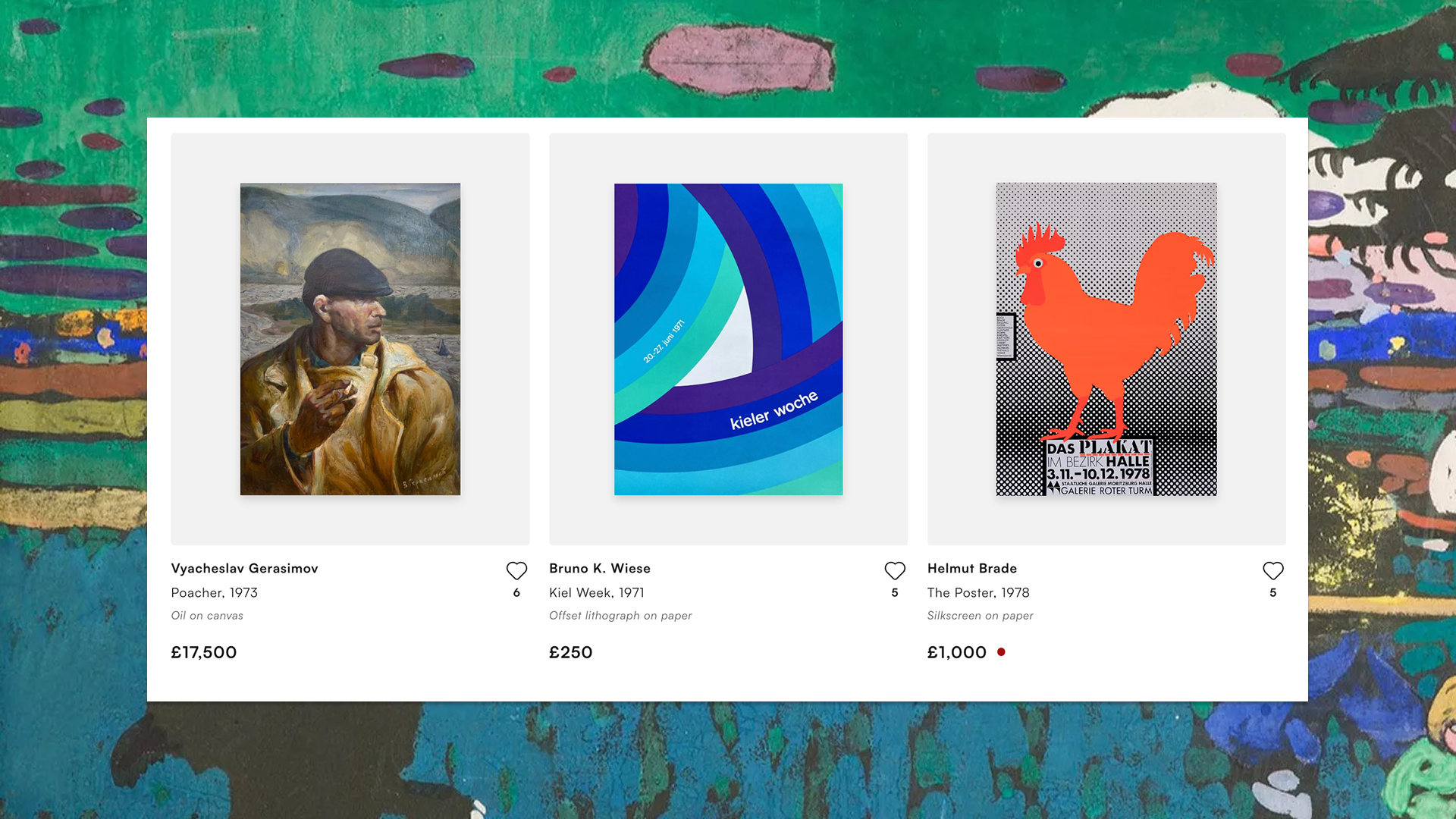
The top tier also serves another purpose: price anchoring. On COMRADE, a $25,000 painting sits alongside a $200 poster. The higher-priced work changes how collectors perceive the prices of everything else. The first number they see can influence what they consider reasonable (Tversky & Kahneman, 1974).
Finally, use round numbers. Research suggests that round prices can work particularly well for purchases driven by emotion (Wadhwa & Zhang, 2015). Art is often one of them.
When someone asks, "How much is this?", you should have an answer. Not spend five minutes calculating a price, second-guessing yourself or wondering whether you've priced it too high or, worse, too low.
Should I discount?
Yes, so leave some room in your price for discounting. Collectors negotiate, and you should leave room for that conversation. In 2024, 55% of collectors negotiated a discount when buying art, most commonly asking for 11% to 20% off (Artsy Collector Insights 2024).
At COMRADE, I discount selectively. I put a small number of works on sale rather than discounting the entire collection. Constant discounting can make art feel like a commodity and train collectors to wait for a sale.
You can also negotiate privately without changing the public price. In KANDINSKY, add selected works to a private room for an individual collector and set a private discount. They see their offer, while everyone else sees the original price.
Should shipping be included in the price?
Always. Show one price, with shipping included.
At COMRADE, I've found that customers will happily spend thousands on an artwork but hesitate when they see an additional $200 shipping charge. The amount isn't necessarily the problem. It's the extra cost appearing on top of a price they've already agreed to.
All online shoppers feel the same. Leaving aside people who were just browsing, extra costs like shipping, tax and fees are the top reason shoppers abandon a checkout, at 40%. Another 12% leave because they couldn't see the total cost up front (Baymard Institute).
£1,000 with shipping included feels better than £950 plus £50 at checkout. It's the same money.
Most galleries still charge shipping on top. Artsy's guide to buying art says shipping is "normally an additional cost" (Artsy). Including it makes you easier to buy from than they are.
Should you show your prices online?
Yes. Hiding prices creates another barrier between a collector and a purchase.
On Artsy, works with public prices are about five times more likely to sell than those without one (Artsy Gallery Insights 2022). 95% of collectors say seeing a price matters when buying art online, and 56% say a missing price is their biggest barrier (Artsy Collector Insights 2024).
"Price on request" asks a collector to contact you before they even know whether a work is within their budget. Most won't bother.
That doesn't mean you need to publish every price. There are good reasons to use POA selectively, particularly for high-value works where you want to discuss the price with a collector before making an offer. But when every work is POA, it becomes a barrier rather than a sales tool. Collectors can't compare works, understand your price range or decide whether to get in touch.
The better approach is to show prices wherever possible and reserve POA for works where a private conversation makes sense.
More on pricing your inventory in Your Website Should Do More Than Showcase Your Art.
FAQ
What's the best pricing strategy for selling art online?
Price by status, not by cost or time. Sell in three core tiers and use them every time. If in doubt, go higher, and always include shipping in the price.
Should I price art by size or by the hours it took?
Size can be a way to sort works into tiers, and many galleries use it. But a work's price bears no relation to what it cost or how long it took to make. It reflects the work's status.
Should I price art high or low?
If in doubt, go higher. You can always give one collector a private discount, but a public price cut can suggest a fall in quality. Over half of collectors negotiate, so a higher price leaves room to say yes.
Should I charge shipping separately?
No. Include it in the price. Extra costs are the top reason online shoppers abandon a checkout, after people who were just browsing.
Should I show prices on my website?
Yes. On Artsy, works with a public price are about five times more likely to sell, and 95% of collectors say seeing a price matters when buying online.